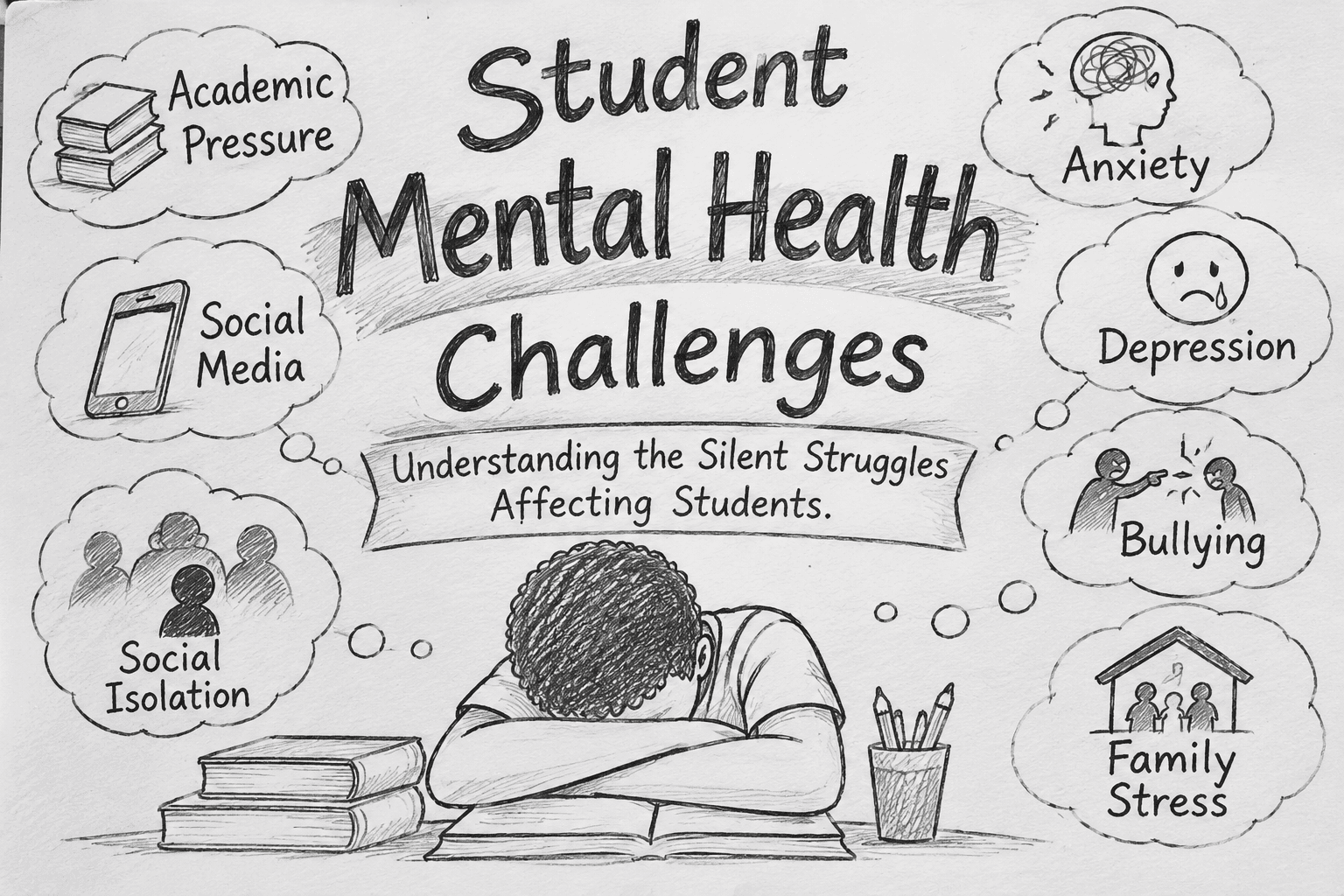
Student Mental Health Challenges: Understanding the Silent Struggles Affecting Students
Student Mental Health Challenges: Understanding the Silent Struggles Affecting Students
Introduction
When we think about education, we often focus on academic performance, examination results, classroom activities, and the ability of students to understand what they are taught. However, there is another important aspect of education that does not always receive the attention it deserves: student mental health.
Behind the classroom activities, homework, examinations, and academic expectations are students dealing with emotional, psychological, and social challenges. Some struggle with anxiety, others experience depression, loneliness, bullying, low self-esteem, or pressure to meet expectations. Unfortunately, many of these difficulties remain unnoticed because students do not always know how to communicate what they are experiencing.
A student may appear physically present in the classroom but mentally distracted by problems that have little to do with the lesson being taught. Another may gradually lose interest in school, withdraw from friends, or experience declining academic performance without anyone understanding the underlying reason.
Mental health is an important part of a student's overall development. It influences how students think, feel, interact with others, respond to challenges, and approach learning.
Understanding the mental health challenges affecting students is therefore essential for parents, teachers, school administrators, and educational policymakers. Supporting students should involve more than helping them achieve good grades. It should also involve creating environments where they feel emotionally safe, respected, understood, and supported.
Understanding Student Mental Health
Student mental health refers to the emotional, psychological, and social well-being of learners. It influences how they manage everyday challenges, build relationships, make decisions, develop confidence, and participate in educational activities.
Good mental health does not mean that a student never experiences sadness, disappointment, anxiety, or frustration. These emotions are normal parts of human development.
The concern arises when emotional difficulties become persistent, overwhelming, or interfere with a student's ability to function at home, in school, or within social environments.
Students experience different challenges depending on their age, family circumstances, school environment, relationships, and individual experiences. While some difficulties may be temporary, others may require professional attention and ongoing support.
Major Mental Health Challenges Affecting Students
1. Anxiety and Depression
Anxiety and depression are significant concerns in student mental health.
Students may experience anxiety because of examinations, academic expectations, family responsibilities, social relationships, financial difficulties, or uncertainty about their future.
For some learners, the fear of making mistakes or disappointing their parents becomes overwhelming. They may constantly worry about their performance, compare themselves with classmates, or feel pressured to achieve unrealistic academic expectations.
Depression can affect a student's motivation, concentration, energy, interests, and relationships. A student who previously enjoyed participating in classroom activities may suddenly become withdrawn or lose interest in learning.
Some possible warning signs include:
- Persistent sadness or irritability.
- Loss of interest in previously enjoyable activities.
- Difficulty concentrating.
- Changes in sleeping or eating habits.
- Withdrawal from friends and family.
- Feelings of hopelessness or worthlessness.
These signs do not automatically mean that a student has depression or an anxiety disorder. However, persistent changes deserve attention and, where appropriate, professional assessment.
2. Academic Pressure and Fear of Failure
Education is intended to develop knowledge, skills, creativity, and critical thinking. However, excessive academic pressure can negatively affect students' emotional well-being.
Many students face expectations to achieve excellent grades, perform better than their classmates, pass important examinations, and secure admission into competitive institutions.
While academic ambition can encourage improvement, excessive pressure can create fear and emotional exhaustion.
Consider a student who consistently performs well in mathematics. Instead of enjoying the learning process, the student becomes frightened of receiving anything below an A. Every examination becomes a test of personal worth rather than an opportunity to demonstrate understanding.
This situation can lead to perfectionism, excessive worrying, reduced confidence, and academic burnout.
Students should understand that making mistakes is part of learning. Academic success should be measured not only by grades but also by progress, effort, understanding, and the ability to overcome challenges.
3. Social Media Influence and Low Self-Esteem
Social media has become an important part of students' social interactions and daily experiences.
Although digital platforms provide opportunities for communication, entertainment, creativity, and learning, they can also expose students to unhealthy comparisons and unrealistic expectations.
Students may compare their physical appearance, clothing, relationships, popularity, and lifestyles with what they see online.
Constant exposure to carefully selected images and videos can create the impression that everyone else is happier, more attractive, more successful, or more socially accepted.
For young people who are still developing their identities, these comparisons can affect self-confidence and body image.
Other concerns include:
- Excessive screen time.
- Social media addiction or compulsive use.
- Cyberbullying and online harassment.
- Pressure to gain likes, followers, and approval.
- Exposure to inappropriate or harmful content.
- Disrupted sleep and reduced concentration.
Parents and teachers should help students develop digital awareness and understand that online popularity does not determine their value as individuals.
4. Bullying and Cyberbullying
Bullying remains a serious challenge in educational environments.
It can take different forms, including physical intimidation, verbal abuse, name-calling, threats, humiliation, social exclusion, and repeated harassment.
Cyberbullying extends these experiences into digital environments through social media, messaging applications, online gaming platforms, and group chats.
For students experiencing bullying, school may become a place of fear rather than an environment for learning and development.
Some students may avoid particular classrooms, stop participating in activities, become socially withdrawn, or develop anxiety about attending school.
Cyberbullying can be particularly difficult because harassment may continue outside school hours, making students feel that they have nowhere to escape.
Schools must establish clear anti-bullying policies, provide safe reporting channels, investigate complaints appropriately, and ensure that students receive support.
Equally important is teaching students empathy, respect, accountability, and responsible digital behavior.
5. Social Isolation and Loneliness
Being surrounded by classmates does not necessarily mean that a student feels connected to others.
Some students attend school every day but struggle to establish meaningful friendships. Others experience rejection, social anxiety, exclusion, or difficulty adjusting to unfamiliar environments.
Transitions between educational levels can make these feelings more challenging. Moving from elementary school to middle school or from middle school to high school often introduces new classmates, teachers, academic expectations, and social groups.
Students who struggle to establish friendships may begin to feel invisible, unwanted, or disconnected.
Loneliness can affect emotional well-being, classroom participation, and confidence.
Schools can help by encouraging collaborative learning, peer mentoring, extracurricular activities, and inclusive classroom environments where students feel accepted.
6. Learning Difficulties and Emotional Frustration
Not every student learns at the same pace or in the same way.
Some students struggle with reading, writing, mathematics, memory, attention, information processing, or other aspects of learning.
When these difficulties are not properly identified and supported, students may begin to believe that they are unintelligent or incapable of academic success.
For example, a student who repeatedly struggles with mathematical concepts may become embarrassed to ask questions. Over time, frustration may develop into avoidance, low confidence, and a dislike of mathematics.
Students with learning differences may also experience additional pressure when their educational needs are misunderstood.
Teachers should recognize individual learning differences, use appropriate instructional strategies, provide additional assistance where necessary, and avoid comparing students unfairly.
Early identification and appropriate educational support can make a significant difference.
7. Family Problems and Financial Stress
A student's emotional well-being is influenced by circumstances outside the school environment.
Family conflict, parental separation, financial instability, housing difficulties, illness, and other household challenges can create emotional stress.
Some students also carry responsibilities that are not immediately visible to their teachers.
For example, a student may be worried about family finances, caring for younger siblings, or dealing with conflict at home while simultaneously trying to complete assignments and prepare for examinations.
These circumstances can affect concentration, attendance, classroom participation, and academic performance.
Educators should recognize that changes in student behavior may sometimes be connected to difficulties outside school.
Building respectful relationships with families and providing access to appropriate school support services can help students navigate these challenges.
8. Sleep Deprivation and Emotional Exhaustion
Sleep is essential for healthy physical development, memory, concentration, and emotional regulation.
However, students may experience inadequate sleep because of academic responsibilities, late-night screen use, extracurricular activities, family obligations, and irregular daily routines.
A student who consistently lacks sufficient sleep may struggle to concentrate, remember information, control emotions, and participate effectively in classroom activities.
Sleep deprivation can also contribute to irritability, reduced motivation, and poor academic engagement.
Parents and educators should encourage healthy sleeping habits and recognize that students need adequate rest to support their learning and development.
9. Peer Pressure and Identity Challenges
Adolescence is an important stage of personal development. During this period, students begin exploring their identities, values, interests, and relationships.
The desire to belong to a social group can sometimes influence their decisions.
Some students may feel pressured to dress in particular ways, adopt certain behaviors, engage in risky activities, or change their personalities to gain acceptance.
Others may struggle with confidence because they feel different from their classmates.
When students believe that acceptance depends on changing who they are, their self-esteem and emotional well-being may suffer.
Schools and families should encourage healthy independence, self-respect, responsible decision-making, and positive friendships.
How Mental Health Challenges Affect Academic Performance
Mental health and academic performance are closely connected.
Students experiencing emotional distress may find it difficult to engage fully in educational activities, even when they have the intellectual ability to understand the subject matter.
Some of the possible effects include:
1. Reduced concentration: Anxiety, emotional distress, and persistent worrying can make it difficult for students to focus during lessons.
2. Declining academic performance: Emotional difficulties may affect memory, problem-solving, assignment completion, and examination preparation.
3. Increased absenteeism: Students experiencing bullying, anxiety, or emotional distress may begin avoiding school.
4. Reduced classroom participation: Fear of embarrassment, low self-esteem, and social anxiety may prevent students from asking questions or contributing to discussions.
5. Behavioral changes: Emotional difficulties may sometimes appear as irritability, withdrawal, aggression, or difficulty following classroom expectations.
6. Loss of motivation: Students who feel overwhelmed may gradually lose interest in learning and extracurricular activities.
7. Difficulty building relationships: Emotional distress may affect how students communicate, cooperate, and interact with their classmates.
These challenges demonstrate why academic achievement should not be evaluated through examination results alone.
What Can Schools and Teachers Do to Support Students?
Teachers are important contributors to students' educational and emotional development.
Although teachers are not substitutes for mental health professionals, they are often among the first adults to notice changes in students' classroom behavior and academic engagement.
Schools can adopt several strategies to support students.
1. Create a Safe and Supportive Learning Environment
Students should feel comfortable asking questions, expressing opinions, and making mistakes without fear of humiliation.
Teachers can establish respectful classroom expectations, discourage discrimination, and encourage positive interactions among learners.
A supportive classroom makes it easier for students to participate and develop confidence.
2. Recognize Changes in Student Behavior
Teachers should pay attention to sudden or persistent changes in attendance, classroom participation, academic performance, social interactions, and emotional responses.
A student who was previously active but becomes unusually withdrawn may need additional attention.
Rather than immediately assuming that the student is lazy or disruptive, teachers should approach the situation with curiosity and appropriate concern.
3. Reduce Unnecessary Academic Pressure
Academic standards are important, but students should not feel that their entire future depends on one examination or assignment.
Teachers can encourage effort, improvement, curiosity, and independent thinking rather than focusing exclusively on grades.
Providing constructive feedback and reasonable opportunities to improve can help students develop confidence.
4. Encourage Positive Peer Relationships
Collaborative learning, group projects, peer mentoring, and extracurricular programmes can help students build friendships and develop a sense of belonging.
Teachers should also ensure that group activities do not become opportunities for exclusion or humiliation.
5. Strengthen School Counselling Services
Schools should provide access to qualified school counsellors and appropriate mental health professionals.
Students experiencing persistent emotional difficulties should be able to seek help confidentially, within the limits of safeguarding requirements.
Where necessary, schools should work with families and qualified professionals to arrange additional support.
6. Promote Digital Awareness
Digital education should include more than teaching students how to use technology.
Students should also understand online safety, cyberbullying, privacy, responsible communication, and healthy screen habits.
Parents and teachers can work together to establish appropriate digital boundaries.
7. Build Strong Relationships With Parents
Communication between schools and families can help identify difficulties early.
Teachers should share relevant observations with parents respectfully and avoid making unsupported assumptions about a student's emotional condition.
When families and schools work together, students are more likely to receive consistent support.
The Role of Parents in Supporting Student Mental Health
Parents play an important role in children's emotional development.
A supportive home environment gives students opportunities to express their feelings, discuss their difficulties, and develop confidence.
Parents should recognize that children may experience emotional difficulties even when they have access to good education, financial support, and other opportunities.
Some practical ways parents can support their children include:
- Listen without immediately criticizing: Allow children to explain their experiences before offering advice or judgment.
- Encourage open communication: Ask about friendships, school experiences, personal interests, and emotional well-being.
- Avoid unhealthy comparisons: Do not constantly compare children with siblings, classmates, or other students.
- Recognize individual differences: Understand that children develop at different rates and have different strengths.
- Encourage healthy routines: Promote adequate sleep, physical activity, balanced nutrition, and appropriate screen time.
- Provide emotional reassurance: Let children know that their value is not determined by their grades or achievements.
- Seek professional support when necessary: Persistent or severe emotional difficulties should not be ignored.
When Should a Student Receive Professional Help?
Not every emotional difficulty requires clinical treatment. However, persistent changes in behavior, mood, sleeping patterns, academic engagement, or social relationships should be taken seriously.
Parents and teachers should consider seeking professional guidance when a student:
- Experiences prolonged sadness or anxiety.
- Frequently expresses feelings of hopelessness.
- Withdraws from friends and family.
- Shows significant changes in behavior.
- Experiences persistent difficulties attending school.
- Expresses thoughts of self-harm or suicide.
If a student expresses suicidal thoughts or appears to be in immediate danger, the situation requires urgent professional attention. In the United States, call or text 988 for crisis support; call 911 for immediate life-threatening emergencies.
Conclusion: Education Must Address Both Academic and Emotional Development
Student mental health should be an important part of every educational conversation.
Students need more than textbooks, examinations, assignments, and classroom instruction. They also need supportive relationships, emotional security, meaningful friendships, and environments where they can develop confidence.
Mental health challenges can affect how students learn, interact, make decisions, and prepare for their futures. Ignoring these challenges may prevent some learners from reaching their full potential.
Teachers, parents, school administrators, counsellors, and policymakers must recognize that supporting students involves understanding both their academic needs and their emotional experiences.
A successful educational system should not simply produce students who perform well in examinations. It should also help young people develop confidence, resilience, healthy relationships, responsible decision-making, and the ability to navigate life's challenges.
Education should develop the mind without neglecting the well-being of the person behind the student.