Smartphones in Schools: How Can We Reduce Distractions and Improve Student Learning?
Introduction: When Technology Becomes a Distraction
Smartphones have become an inseparable part of everyday life. For many middle and high school students, a phone is more than a communication device. It is a source of entertainment, social interaction, information, and personal connection.
While technology has created new opportunities for learning, its increasing presence in schools has also introduced a significant challenge: distraction.
A student may be physically present in the classroom but mentally occupied with social media notifications, text messages, online games, videos, or conversations happening outside the classroom. Even a quick glance at a phone can interrupt concentration and make it difficult to return to a lesson.
For teachers, this creates an additional challenge. Instead of directing all their attention toward teaching and supporting students, they may find themselves repeatedly reminding learners to put their phones away.
The question, therefore, is not simply whether students should have access to smartphones in school. It is how schools can establish a healthy balance between technology, student responsibility, and meaningful learning.
1. Understanding Why Students Are Easily Distracted by Phones
Before addressing phone distraction, it is important to understand why smartphones are so appealing to young people.
Social media platforms, online games, short videos, and messaging applications are designed to encourage repeated engagement. Notifications and constantly changing content can make students feel the need to check their phones, even when they know they should be concentrating.
For middle and high school students, social relationships are also an important part of their daily experiences. They may feel pressure to respond immediately to friends, follow online conversations, or remain updated about what is happening on social media.
Some students also use their phones as an escape when they find a lesson difficult, boring, or overwhelming.
This means that phone distraction is not always simply a discipline problem. It can also involve habits, emotional needs, peer influence, and difficulties with self-regulation.
Understanding these factors helps schools develop solutions that address the behaviour rather than relying entirely on punishment.
2. Establishing Clear and Consistent School Phone Policies
One of the most effective ways to manage phone distractions is to establish clear expectations.
Schools should develop policies that explain when students may use their phones, where devices should be kept, and what consequences apply when rules are ignored.
For example, schools could implement the following approaches:
- Phones remain switched off or placed on silent during instructional periods.
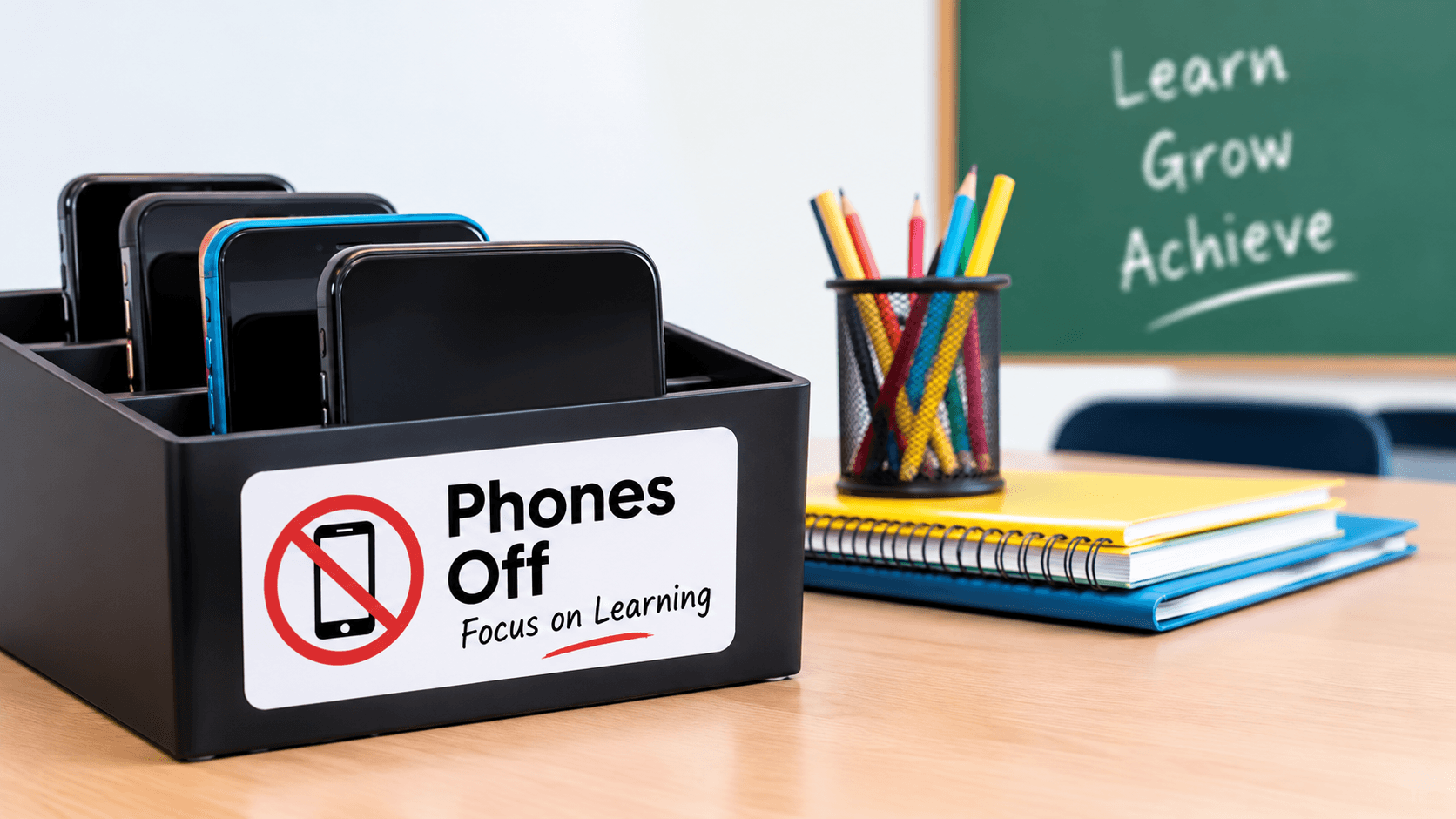
- Students keep their phones in designated storage areas, lockers, or secure classroom pouches.
- Phone use is permitted only when a teacher specifically authorizes it for an educational activity.
- Students may access their devices during designated times if school policy permits.
- Emergency communication procedures are clearly explained to students and parents.
Most importantly, these expectations should be consistently enforced across classrooms.
When one teacher strictly enforces the policy while another allows unrestricted phone use, students may become confused about acceptable behaviour.
Consistency creates a learning environment where students understand that classroom time is reserved for learning.
3. Making Classroom Learning More Engaging
Managing phone distractions should not depend entirely on restricting access to devices. Schools must also examine the learning experience itself.
Students are more likely to remain attentive when lessons are meaningful, interactive, and connected to their interests.
Teachers can incorporate different instructional approaches, including:
Project-Based Learning: Give students meaningful projects that require investigation, creativity, teamwork, and practical problem-solving.
Hands-On Activities: Use experiments, demonstrations, group assignments, and classroom challenges to encourage active participation.
Classroom Discussions: Encourage students to express their opinions, ask questions, and participate in conversations.
Real-World Connections: Relate mathematics, science, technology, and other subjects to situations students encounter in everyday life.
For example, rather than simply explaining mathematical concepts, a teacher could ask students to develop a budget for a small business or investigate how percentages are used in shopping and financial decisions.
When students become actively involved in learning, they have more reasons to direct their attention toward the classroom.
However, engaging lessons should complement phone policies, not replace them. Even an interesting lesson can be interrupted by unrestricted access to digital notifications.
4. Teaching Students Digital Discipline and Self-Control
One of the most important lessons schools can teach students is how to manage technology responsibly.
Simply taking phones away may reduce immediate classroom distractions, but students also need to develop the ability to regulate their own behaviour.
Digital literacy education should therefore include discussions about:
- The effects of excessive screen time on daily routines.
- How social media notifications influence attention.
- The importance of concentrating on one task at a time.
- Responsible online communication.
- Cyberbullying and digital safety.
- The difference between productive and unproductive screen use.
Students should also learn that being constantly available online is not a requirement.
Developing the ability to put a phone aside, concentrate on a task, and complete work without checking notifications is an important life skill.
These habits will benefit students beyond school, including in higher education and future employment.
5. Involving Parents in Managing Smartphone Use
Schools cannot address this challenge independently. Parents and guardians have an important role to play in shaping students' technology habits.
When schools establish phone restrictions but students have unrestricted access to their devices outside school, maintaining healthy habits can become more difficult.
Parents can support their children's learning by:
- Establishing reasonable screen-time expectations at home.
- Encouraging phone-free study periods.
- Avoiding unnecessary messaging during instructional hours.
- Discussing responsible social media use.
- Encouraging reading, physical activities, hobbies, and face-to-face interactions.
- Modelling healthy smartphone habits themselves.
Schools should also communicate their phone policies clearly to families so parents understand the reasons behind the restrictions.
A consistent approach between home and school can help students develop better self-management habits.
6. Using Technology as a Learning Tool Rather Than a Distraction
It is important to recognize that smartphones are not inherently harmful to education.
When properly managed, digital devices can support research, collaboration, creativity, and independent learning.
For example, teachers may authorize phone use for:
- Accessing educational applications.
- Conducting research on approved websites.
- Participating in classroom polls and quizzes.
- Recording observations during science activities.
- Photographing experiments and project outcomes.
- Accessing digital learning materials.
However, educational use must be intentional and supervised.
Schools should distinguish between using technology to achieve a learning objective and allowing unrestricted access to entertainment and social media during instructional time.
The goal should be to help students become responsible users of technology rather than completely disconnected from it.
7. Creating a School Culture That Respects Learning Time
Policies are more effective when students understand the reasons behind them.
Instead of presenting phone restrictions only as punishment, schools should involve students in conversations about concentration, academic performance, classroom respect, and healthy technology habits.
Student councils, classroom discussions, and digital citizenship programmes can provide opportunities for learners to contribute ideas and understand their responsibilities.
Schools can also introduce initiatives such as:
- Phone-free classroom challenges.
- Designated device storage systems.
- Recognition for responsible digital behaviour.
- Workshops on attention and time management.
- Regular discussions about the relationship between technology and academic success.
When students understand that these measures are designed to protect their learning time, they are more likely to participate in creating a positive classroom environment.
Conclusion: Protecting Students' Attention in a Digital World
Smartphones are not going away, and technology will continue to influence how young people communicate, socialize, and learn.
However, access to technology should not come at the expense of education.
Middle and high school students need opportunities to develop concentration, patience, critical thinking, communication, and self-discipline. These abilities require time, practice, and an environment where students can engage meaningfully with their learning.
Schools must therefore establish clear phone policies, provide engaging instructional experiences, teach digital responsibility, and work closely with parents.
The objective is not simply to remove smartphones from classrooms. It is to help students understand when technology is useful, when it becomes a distraction, and how to exercise control over their digital habits.
A classroom should be a place where students are mentally present, actively engaged, and able to give their attention to the opportunities in front of them.
At Gablyn Learning Place, we believe that preparing students for the future involves more than teaching academic subjects. It also means helping them develop the discipline, awareness, and responsibility needed to thrive in an increasingly digital world.
Technology should support learning, not compete with it. And sometimes, the most productive thing a student can do with a smartphone is put it away and focus on learning.